
Starting viva week, we were sent a list of potential topics we could cover for our final major project. The topics given were:
- Re-tell, reboot, reimagine
- Fake news
- Screen life
- Discarded
- The role of the Observer – In today’s society and with the digital revolution we are constantly observing and being observed
For this project, we were given the choice of working individually or in a group. I have chosen to work in a group with Cheye and Hannah as we share share similar ideas and have worked well together on previous projects.
Our deadline for this project is the 24th of May 2019.
Rationale
Throughout the first 7 units, I learned new skills in all classes. In TV and Film, I’ve learned the correct processes in pre-production, production and post-production and have learned to better my editing skills. In audio, I have learned how to identify audio elements and create a soundtrack, implementing these elements. In photography, I learned how to operate a camera and edit images on Photoshop and in animation, I have learned how to create a title sequence and use other methods in animating. In all classes I have also learned to use different Adobe software such as Photoshop, Premiere and After Effects.
For me, learning these new skills/methods means I have advanced in the course and have learned a better understanding of terms and methods used in the media industry.
Compared to what I now can do in the production process, I knew little to nothing before starting this course. Before starting the course, I knew basic media terms, but since advancing in the course, I have learned more terms and methods used in the industry.
Project Concept
Our project concept is to create a documentary about the social networking platform ‘YouTube’. We will be researching the history of YouTube and analyse how it has grown to be the popular website it is today. We will discuss the possibility of YouTube being a future career for younger generations and talk about the positives and negatives of YouTube. We will interview different generations of people to get a good understanding of what type of people use the platform and find out what they use it for. We have decided to create an idea based on the topic of screen life, as we wish to discuss the good and bad points of being behind the screen viewing YouTube as a regular user and as someone who makes a living on the platform. We will get feedback from younger generations and parents/adults.
We will produce a non-biased documentary, exploring the good and bad sides of YouTube. We will be discussing various sub-topics to further points and ideals that different people have about YouTube.
For resources, we will be using YouTube itself to explore the various genres of videos that get uploaded. As well as this, we will interview people on the platform and talk to younger groups of people to get their opinions on YouTube. We will also be creating surveys for older and younger generations to collect feedback on what they use the platform for.
I have chosen to create a documentary as these types of videos tend to be more informal and non-biased. We will be presenting the documentary as an unbiased piece, however we will dedicate a section at the end of our project to discuss our personal feelings on our chosen topic and our own experiences.
We will have seven weeks to create our FMP. In our group, we will be managing times and allocating time slots to get parts of the documentary completed.
Evaluation
Throughout the FMP, we will be writing up what we have done on our blogs, so that we can later reflect on our work once the project is completed. We will also be recording our decision-making process using various methods. We will be recording the decision-making process on our blogs and will also have production meetings to discuss what work needs to be completed.
Working in a group, we will contribute a mixture of our own ideas and ideas generated as a group. In groups, there is a chance of members disrupting each other. If there are any problems, we will resolve them by managing our time and discussing what needs to be completed.
Idea Generation
Topics We Could Choose:
- Re-tell, reboot, reimagine
- Fake news
- Screen life
- Discarded
- The role of the Observer
In today’s society and with the digital revolution we are constantly observing and being observed.
Idea 1 – Bruce Almighty
For our project, we first considered covering the topic of re-tell, reboot or reimagine.
Generating ideas for what we would like to recreate, we considered various movies. One movie that we almost chose to recreate scenes from was ‘Bruce Almighty’. Due to the story of this film (a man gaining powers of a God), there were a lot of scenes that had potential to be remade. One scene we particularly liked was the following:
At the start of this video, the protagonist is seen walking on water, an effect that was portrayed very well in the movie. Wanting to learn how this effect was produced, I searched YouTube to see if there were any tutorials available showing how to create this effect. Thankfully, there was. The following tutorial showed me how this effect could have been created.
In the tutorial video, the video-maker, ‘Jordy’ created a wooden board that could placed in the water and later walked on it to create the effect. Jordy ran into a problem when creating this video as the wooden board floated when one side of it was stood on. To overcome this issue, he attached rocks to the board to ensure it wouldn’t float. After this, Jordy filmed him walking on this board in the water with part of the shore being visible in the recording.

After this, Jordy recorded the lake on it’s own, with no shore present in the video. In Premiere Pro, he then showed how by placing the video layer with just the water above the walking on water layer, it could then be merged together using feathering to create this realistic and believable effect.

This was a surprisingly easy effect to recreate, however, we decided against recreating Bruce Almighty due to other ideas we had in the idea generation process.
Idea 2 – Star Wars
Another film I considered remaking a scene from was ‘Star Wars: The Phantom Menace’. Being a huge Star Wars fan, I wanted to recreate a fight scene between the characters ‘Qui-Gon’ and ‘Obi-Wan’ against the villainous ‘Darth Maul’. The following is the scene that I wanted to recreate:
Visually, this scene is pleasing as the characters take part in a huge battle and seeing the effects of the lightsabers adds to this scene looking visually good. I also wanted to recreate this as the music and foley used adds to the tension of the scene. Thinking about audio elements to create for my FMP, this would have been a good scene to recreate, however I preferred other ideas when discussing them, so decided not to make my own version of this scene for my FMP.
Wanting to learn how to create the effect of a lightsaber, I searched for a tutorial on YouTube. The following video is the tutorial that I researched:
In this tutorial, the creator of the video shows how this effect is made using masking layers on After Effects. Not knowing a lot about After Effects, this did deter me from recreating this scene, however, eager to overcome my lack of knowledge, I watched the video to further learn how to make this affect. Overall, after learning how to create this effect, I don’t think the scene would have been too difficult to recreate, however, due to us preferring a different idea from the idea generation process, we chose not to recreate this scene from Star Wars.
Idea 3 – YouTube Documentary (My Chosen Idea)
When considering the topic of screen life, I started to think about how an idea could be applied to a general audience. I began to generate ideas for what social media platforms people use the most and being an avid user of the platform ‘YouTube’, I became invested in the idea of creating a documentary centralized on this platform. As a group, we further discussed the potential of YouTube being our chosen idea to create a documentary about. Applying everyone’s prior knowledge and experiences on the website, we decided it would be a good basis for a documentary to be made about. As well as this, with us all of us having had good experiences on the website, we wanted to learn more about the negative side of YouTube. With the topic of YouTube, there is a lot of potential in terms of primary and secondary research. For primary research, our group intends to create questionnaires and interview a YouTube creator who makes a living on the website. As for secondary, YouTube itself offers various videos and content creators to explore, whereas we also intend to educate ourselves more on the layout of a documentary by researching some. Our documentary will be roughly between 10-20 minutes long. Although there is a lot to cover on this topic, we don’t want to drag on any points for longer than required and instead, get into each point in full detail in good time. Also, if our documentary is too long in length, viewer abandonment is more likely to occur as not everyone may have the time to watch a long documentary about YouTube.
Uploading The Project
After the documentary has been created, I intend to upload it to my YouTube channel. I believe it is important to upload our documentary to YouTube, so that anyone who watches it on the platform will be further educated on the website they are using.
My Channel Link – https://www.youtube.com/channel/UCiD_qptIWFR3Dnm3edY1ByA

Target Audience
For this project, we intend to create this documentary aimed at parents and adults. We wish to provide information to inform older generations about the good and bad sides of YouTube. Additionally, parents (who may allow their children to watch YouTube) can be further educated on the safety of allowing their children to access the website. An adult audience may vary in age and could be anywhere between ages 25 and onward. Although our primary target audience is parents and adults, we also wish to inform younger generations of the realism of being a full-time YouTube creator and how hard it may be to create content consistently. We will do this by applying our own experiences, interviewing a YouTube star and applying our primary and secondary research.
Unique Selling Point/USP
For our project to stand out, we will need to have a unique selling point that is exclusive to our idea. Our documentary will have two unique selling points. The first unique selling point for our project will be our group attending a secondary school class to show a presentation to a younger audience and then interview them. To do this, we will need to get permission from the school, which if refused will leave us without this USP.
Our second USP will be our group travelling to YouTube Space in London to interview members of staff and other YouTubers. I know this will be a good USP as I believe no one else will go the effort of sorting through paperwork, travel arrangements etc. for a trip to such a distant city. As well as this, the trip to YouTube Space will provide helpful research that will be applied to our project.
Mind Map
For my project, I created a mind map in order to generate ideas for what would be included in the YouTube documentary. I ended up creating a lot of sub-topics that would later be discussed about in the documentary for YouTube.
We intend on starting the documentary by giving a brief history of YouTube. From the ideas generated on my mind map, I will discuss the first wave of viral videos that gave YouTube the attention that it did. I will also go into detail on how YouTube managed to sustain it’s popularity as time passed and talk about other videos and content creators that kept an audience returning to the platform. YouTube has a rich history of viral videos. Some of the most popular and well-known include ‘Charlie Bit My Finger’ (uploaded May 22nd 2007) and ‘Numa Numa’ (uploaded December 11th 2006).
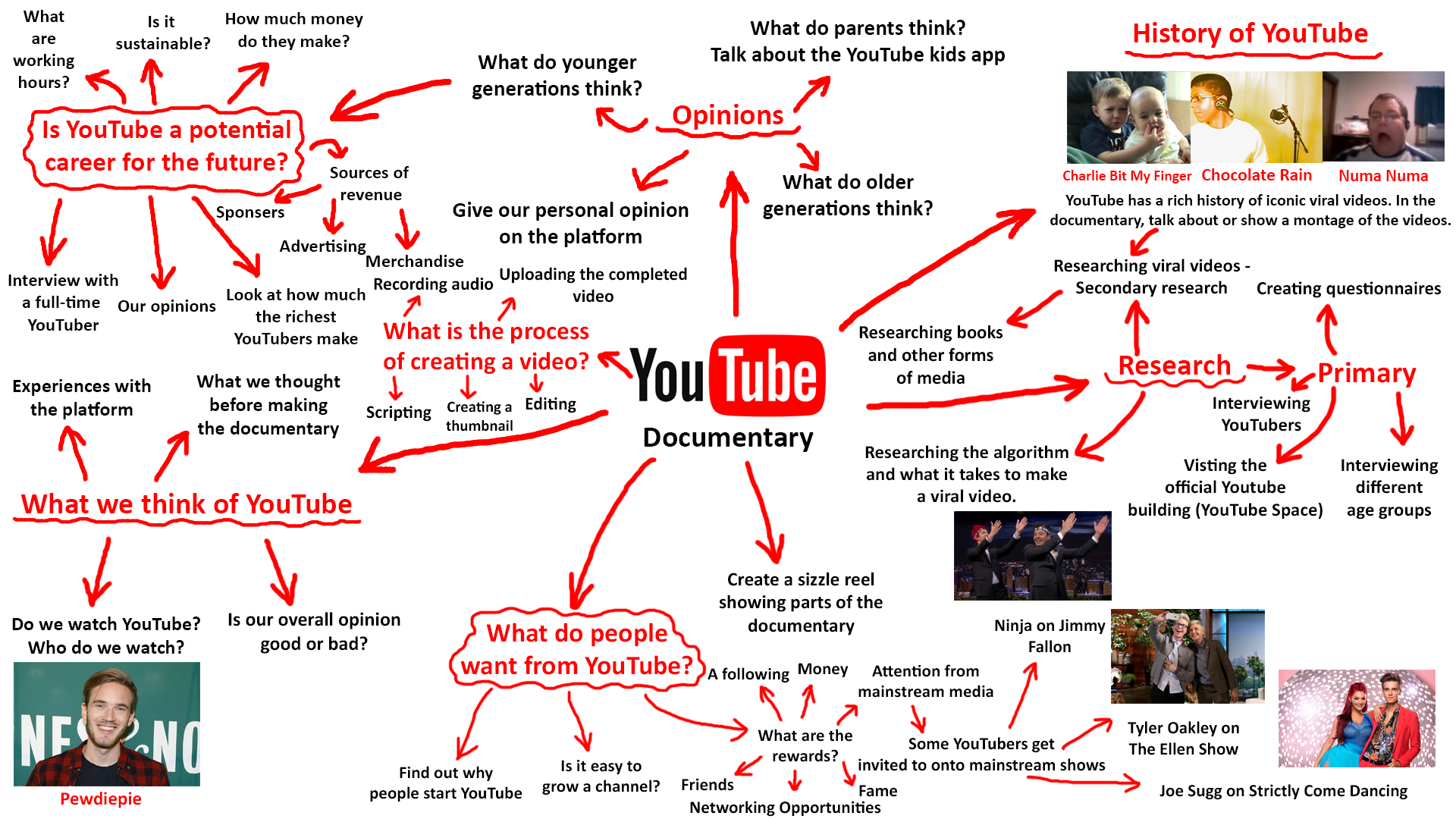
Another idea we had for our documentary that originated from the idea generation/mind-mapping process was to discuss if YouTube could potentially be a career for current and future generations. For this, we intend on talking about sub-topics like if YouTube is a sustainable platform and discuss other potential sources of revenue surrounding YouTube. We also plan to interview a full-time YouTuber to get their opinions on the platform and to get more educated on what it is like to create videos on YouTube on a full-time basis. As well as this, we’d like to discuss at what point creating YouTube videos becomes a full-time job and how likely it is to generate a living wage on the platform.
After thinking of the topic of YouTube being a full-time career, my next idea that follows on my mind map is what do people want from YouTube? For this section of the documentary, I intend on finding out why it is that people begin making videos in the first place and what rewards they think will follow. We will delve into finding out what comes from running a popular YouTube channel, be it financial benefits, an audience etc. Branching off from this topic, we will also discuss current YouTubers who are thriving on the platform and acknowledge their break into mainstream media.
Research is another important process for creating this documentary. On my mind map, I have identified various methods of research for this project. We will be creating questionnaires to hand out to the adult demographic to find out what they think about YouTube. We also intend on creating a similar questionnaire for a younger demographic. From both questionnaires, we will compare and analyse the results and discuss the differences/similarities in our documentary. We will also be visiting the YouTube Space London building to interview the workers of YouTube to get their opinions on the platform for a wider range of results. For secondary research, we will be investigating viral videos from YouTube and take a look at various content creators and their contributions to the platform.
Although the documentary will be unbiased, towards the end of the project, we will dedicate a section to our personal opinions and experiences with YouTube. We wish to do this as different members of our group working on the project have different thoughts about the platform and by giving our own opinions, we will be providing a wider perspective of YouTube. We also have our own experiences on YouTube, so it will be interesting delving into what each member of the team has experienced on the platform. As well as this, in this section, each of us will talking about our prior knowledge of YouTube and our thoughts going into this project.
Timeline for our Documentary
To keep a balanced structure, we decided to create a timeline for our documentary. This timeline includes all the different sections we intend on discussing throughout the documentary.

On our timeline, we designated different sections to members of the group. As well as the history of YouTube, opinions section, YouTuber interview and visit to YouTube Space, I will also be discussing if YouTube can be a potential career for current and future generations.
As a group, we had a discussion over who would be covering what topic and assigned ourselves sections to cover. We chose the topics (that we would be covering solo) that interested us, as we would want to delve further into detail on that topic.
Project Plan
For this documentary, I will be adhering to a project plan that was created in order to get tasks completed by a designated deadline.

Pitching My Idea
I had to present my idea for my FMP to other members of my mentor group and I had to sell the idea that I chose to create. After discussing the project I wished to create, I received constructive criticism for my peers which I had to work on. Firstly, I was told to research further into what documentary style I would be applying to my work. To do this, I will be researching different documentaries and learn more about how they are created. I was also advised by my peers to research ‘Voice of God’ to learn more about what goes into creating a documentary. Finally, I was advised to consider how the documentary was going to be edited. This project will be the longest that I have worked on, so myself and my group have appointed members with particular sections to edit. After we have edited our sections, we will compare our work and compile the edited sections to create the documentary, adding any necessary changes.
Bibliography
ABC News. (2018). Logan Paul interview: YouTube star speaks out after controversial video. Available: https://www.youtube.com/watch?v=-yx0bTPVob0. Last accessed 9th April 2019.
ABC News. (2019). Do the #ScreenTime Challenge: Here’s how.Available: https://abcnews.go.com/Technology/screentime-challenge/story?id=62729959. Last accessed 3rd May 2019.
Artyom Dogtiev. (2019). YouTube Revenue and Usage Statistics (2018). Available: http://www.businessofapps.com/data/youtube-statistics/. Last accessed 7th May 2019.
Benjamin Burroughs. (2017). YouTube Kids: The App Economy and Mobile Parenting. Available: https://journals.sagepub.com/doi/full/10.1177/2056305117707189. Last accessed 7th May 2019.
Brian Koerber. (2018). Logan Paul wishes his fans were older. They’re not.. Available: https://mashable.com/2018/02/01/logan-paul-young-fans-demograpphic/?europe=true. Last accessed 9th April 2019.
Cinecom.net. (2018). WALK ON WATER like BRUCE ALMIGHTY in Premiere Pro. Available: https://www.youtube.com/watch?v=sGRRYiTzvg4. Last accessed 27th March 2019.
collaborativedocumentary. (2009). Collaborative Documentary Workshop Porto ’09. Available: https://collaborativedocumentary.wordpress.com/6-types-of-documentary/. Last accessed 14th May 2019.
Filmic Box. (2019). Qui-Gon & Obi-Wan vs Darth Maul | Star Wars The Phantom Menace (1999) Movie Clip. Available: https://www.youtube.com/watch?v=Fed9rBMOpJ4. Last accessed 27th March 2019.
Lily Katz. (2019). Best USB Microphones. Available: https://www.soundguys.com/best-usb-microphone-7977/. Last accessed 17th May 2019.
Lucama00. (2009). Jim Carrey I’ve Got The Power. Available: https://www.youtube.com/watch?v=VauzhTAuoFw. Last accessed 26th March 2019.
Nelson Walker. (2019). Types of Documentary Styles. Available: https://collab.its.virginia.edu/wiki/toolbox/Documentary%20Types.html. Last accessed 14th May 2019.
Stuart Miles. (2018). What is Apple Screen Time and how does it work?. Available: https://www.pocket-lint.com/apps/news/apple/144733-what-is-apple-screen-time-and-how-does-it-work. Last accessed 3rd May 2019.
Tanya Chen. (2019). A Mom Found Almost A Dozen YouTube Kids Videos Showing Suicide, School Shootings, And Abuse. Available: https://www.buzzfeednews.com/article/tanyachen/mom-discovered-youtube-kids-shows-school-shootings-violence. Last accessed 7th May 2019.
Will Carmack. (2019). STAR WARS Lightsaber Tutorial | After Effects.Available: https://www.youtube.com/watch?v=GaOZOnVcE-M. Last accessed 27th March 2019.
 Dan Parfitt
Leave a comment